The UK elderly care sector is undergoing a period of significant transformation, driven by unprecedented levels of investment and consolidation. At the centre of this shift is Welltower Inc., a US property management firm valued at $145.9bn (£108.38bn) that focuses on rental housing for ageing seniors across the US, UK and Canada, with a portfolio of over 2,500 seniors and wellness housing communities. Last October, Welltower announced US$14bn of acquisitions, primarily comprising high-quality seniors housing communities in the UK.
Over the past 12-18 months, Welltower has deployed billions into the UK care home market, completing landmark acquisitions including Barchester Healthcare, HC-One, and Aria Care. Collectively, these transactions represent one of the largest consolidations the sector has seen, with more than £7 billion invested in UK care assets in 2025 alone.
This scale of investment reflects growing global confidence in the UK’s long-term care market. Strong private-pay demand, rising fee levels, and favourable demographic trends continue to position the UK as one of the most attractive healthcare real estate markets in Europe.

Tom Berrisford, Divisional Director of Elderly Care at Compass Associates, provides comprehensive analysis of how the major Welltower investment at the end of last year has impacted recruitment in the elderly care sector. He explains how providers are pivoting toward the private market due to cost pressures and how Welltower’s portfolio strategy differs between commercial and local authority-focused homes.
Welltower’s investment in HC-One in particular has created ripples within the market. Concerns about the scale of the investor (and the historical precedent of Southern Cross, which was ultimately shut down by the CQC) have made many uncertain about what’s to come. While not actively job-seeking, candidates are increasingly open to exploring opportunities amid concerns about redundancies.
A large number of care homes across multiple local markets are under review by the Competition and Markets Authority (CMA), the outcome could set an important precedent for future investment activity – particularly around how scale and market influence are balanced against choice and quality of care.
Welltower’s argument to the CMA is that the acquired groups are operationally distinct, with some focused on private care, others on local authority and public-funded care, and should therefore be treated as separate portfolios. The underlying strategy centres on growing the self-pay market.
How is this effecting the elderly care job market?
“What we’re currently seeing is a significant shift in both the job market and the candidate market. While many individuals are not actively seeking new roles, there is a growing sense of caution. People are increasingly open to exploring opportunities due to concerns around job security and the potential for redundancy.”
Redundancies have occurred primarily at senior management level, creating broader nervousness throughout the market. What we are seeing though, is a sharp increase in commercial sales and marketing appointments as businesses pivot towards private-pay growth. In one day alone, two Sales and Marketing Director roles came across my desk very recently. Clients are struggling to attract and retain staff in older-stock care homes where high rents and operational costs are squeezing margins, making commercial talent ever more critical.
What are candidates prioritising?
“We’re increasingly seeing candidates who aren’t motivated purely by salary. For many, the priority is quality of care, safety, and long-term career integrity. If they feel those standards are being compromised, whether through reduced staffing or lack of resources, they are willing to move. Often for the same salary or even slightly less, in order to protect their professional reputation and deliver the level of care they believe in.”
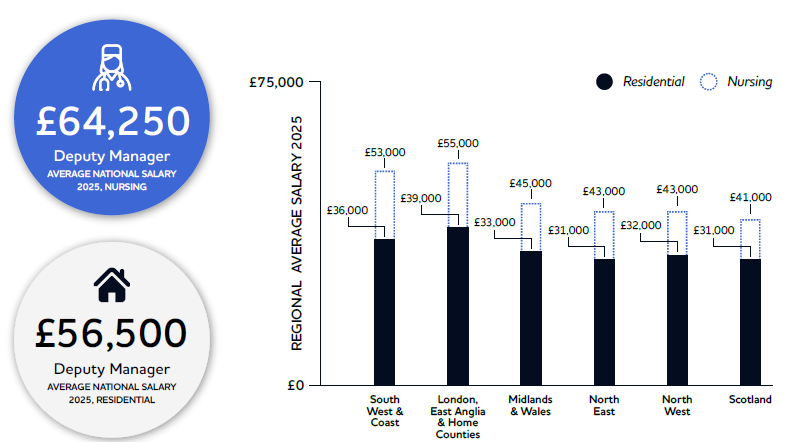
Investment in people has become a key differentiator for candidates, frequently taking precedence over higher pay. Movement in the market is increasingly driven by concerns around quality of care, safety, staffing levels, and reputational risk. That said, salary remains important, particularly in areas facing intense competition and ongoing skills shortages.

So what advice are we giving to clients hiring within Elderly Care?
Consider the implications for talent and leadership
Welltower’s strategy signals a broader shift towards platform-led investment, where scale, operational efficiency, and long-term operator partnerships are paramount. While the sector remains fragmented, large institutional investors are increasingly pursuing buy-and-build strategies to create integrated care platforms. For our clients, this means improved access to capital and infrastructure, but also rising expectations around performance, governance, and reporting.
As investment accelerates, so too does demand for experienced leadership. Larger, more complex organisations need individuals who can operate at scale, who are adapt at balancing commercial performance with quality outcomes. We are already seeing increased demand for regional and executive-level hires, greater emphasis on data-driven decision making, and a growing preference for commercially astute leaders with multi-site experience. To reach these candidates, businesses need a compelling and differentiated talent proposition.
The most effective hiring managers articulate a clear and honest narrative about what makes their organisation a genuinely good place to work. This should cover culture, career development, quality of care standards, and the stability of the business.
In a market where candidates are increasingly driven by values alignment and reputational considerations, the ability to demonstrate strong leadership, a well-resourced environment, and a credible vision for the future will carry far more weight than a marginally higher salary package. Organisations that invest time in defining and communicating this story will consistently outperform those that rely on compensation alone.
Give thought to AI adoption and hire accordingly
We all know that this market is not by any means ahead of the game in embracing tech, however I am seeing a growing expectation that technology-focused leadership will become standard within elderly care. This is already taking shape, as seen in recent appointments such as Oakland Care’s hire of a Head of AI.
Individuals with expertise in AI, data modelling, and digital transformation are increasingly viewed as breakthrough hires for the sector – capable of modernising systems, improving efficiency, and enhancing care delivery.
I believe that providers not yet having these conversations risk falling behind in both the care they can offer and the type of talent they can attract and retain.
Prioritise attraction and retention
“One of the key challenges our clients face is high attrition, often driven by a lack of infrastructure, insufficient systems, or limited support. Today’s workforce expects more in terms of development, engagement, and operational efficiency and where this is lacking, retention inevitably suffers. The priority should be a dual focus: strengthening retention strategies while continuing to invest in new talent. By doing so, organisations can build a more stable, capable, and future-ready workforce.”
Slow processes, poor communication, and a lack of transparency are among the most common reasons strong candidates disengage and the cost of losing a high-quality hire at the final stage is significant in a competitive market. Hiring managers who treat candidates as they would clients (with responsiveness, clarity, and genuine engagement) send a powerful signal about the broader culture. Equally, involving senior leaders early in the process, offering meaningful insight into the role’s impact, and providing a realistic picture of both the opportunity and the challenges ahead builds the kind of trust that converts interest into commitment.
Investment in training, career development, and candidate experience should be central to recruitment strategy. A well-structured induction process is essential to reducing frontline turnover and without stability in frontline teams, consistently high-quality care is very difficult to sustain.
Take a structured approach to workplace planning
Finally, many of our clients are setting ambitious growth plans but underestimating the time and complexity involved in delivering them. Sustainable change requires careful planning, realistic timelines, and clear processes from the outset. We would recommend starting a hiring process at least 3 months before a required start date. For specialised and senior-level appointments, candidates with immediate availability will rarely meet the full requirements of the role. As such, a structured approach underpinned by a clear understanding of recruitment processes and timelines is essential to achieving successful outcomes.
A common challenge we observe is the underestimation of how long hiring can take. For senior leadership roles, the sourcing phase alone typically requires a minimum of two weeks, followed by a thorough interview process of around three weeks. This results in an initial timeline of approximately five weeks, although more complex searches can extend to eight weeks or beyond. In addition, notice periods must be factored in, often ranging from three to four months – particularly where candidates are aligned to bonus cycles or year-end transitions. In total, it is not uncommon for the full recruitment lifecycle, from initial briefing to start date, to span up to six months.
Taking a proactive, well-informed approach to hiring timelines enables organisations to secure the right talent, rather than having to make compromises under time pressure.
Looking for recruitment support?
My team works closely with organisations across the sector to provide tailored advice on workforce planning, market intelligence, and talent acquisition to ensure our clients are well positioned to attract, retain, and develop the leadership they need.
If you are reviewing your hiring plans or would welcome a strategic conversation about your future workforce, we would be delighted to support you.
Looking to understand regional average pay structures in Elderly Care?
Access our free benchmarking report