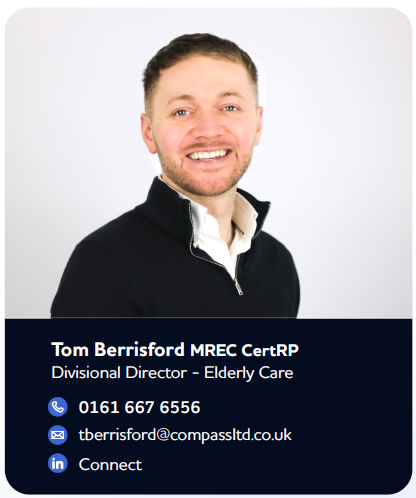
Tom Berrisford, Divisional Director of Elderly Care at Compass Associates
In the second article of our series exploring how to build successful, long-serving commercial capability in elderly care, Divisional Director Tom Berrisford discusses why digital is becoming increasingly important in the sector and how organisations can make the most of its potential.
Providers are increasingly focused on maintaining occupancy levels above 90%, but the journey to achieving this now begins well before a family picks up the phone. Providers can no longer rely solely on being the closest geographically or being the most cost-effective option – families are researching providers online, comparing ratings and reviews, and forming impressions before making initial contact
As a result, the customer experience begins long before a prospective resident or family member walks through the doors of a care home. A provider’s digital presence, reputation and responsiveness are becoming increasingly important factors in the decision-making process.
“Families expect a timely response. A long wait after an inquiry can push them to look elsewhere, even when the home itself is attractive. The service experience around that first contact matters as much as the facilities or the care rating.”
Why response time is now a commercial metric rather than a courtesy
This is one of the clearest shifts I am seeing this quarter. A family that inquires and does not hear back promptly will very often look elsewhere, regardless of how strong the home itself is on facilities or care quality. The journey continues through contact with a home manager, a deputy, or increasingly a dedicated customer relationship manager, and how that early contact is handled can shape a family’s decision as much as the CQC rating or the physical environment of the home.
That puts response time, tone and follow-through squarely in commercial territory. Providers that treat the inquiry stage as an administrative task rather than a customer-service moment are, in effect, leaving occupancy on the table.
Digital discovery has changed where the decision starts
As the baby boomer generation increasingly enters elderly care, their tech-savvy millennial families are playing a more active role in researching and evaluating care options. Online information, reviews and ratings, particularly on platforms such as carehome.co.uk, are becoming a more important part of the decision-making process than ever before and providers are adapting to meet this need.
Providers who recognise the importance of their online ratings, and who invest accordingly in digitalisation and marketing, are better placed to be found and trusted before a family ever makes contact.
Digital and marketing roles focused on managing online traffic, improving visibility on ratings platforms and generating website engagement are growing in demand in this sector as a result, though how much dedicated budget providers allocate to this is still varied. What is consistent is that candidates in these roles do not necessarily need a background in elderly care, but they do need to understand how to market a physical, residential service, not a generic product, and to engage properly with the service itself rather than working only from a screen.
Why this marketing needs to feel personal, not polished
One distinction is worth making clear here: this is not the kind of marketing that leans on a big, glossy commercial feel. Elderly care marketing needs to be grounded, personable and genuinely person-centred, because the product is not a pen or a piece of software that behaves the same way every time. Every home, and every family’s experience of that home, is different, and the best commercial and digital people in this sector understand that authenticity matters more than polish. That is also part of why CRM roles specifically, people embedded in a service rather than working from a central office, are becoming more common: it is very hard to market a home authentically without being in it.
Technology supports the human relationship; it does not replace it
There is a role for technology here, including tools like AI to help move inquiries toward a meeting with a home manager more quickly, but this sector is not, and should not try to become, a technology-led industry. The human element remains central to social care, and technology works best when it is used selectively, to remove tasks that take time away from human interaction rather than to substitute for it.
Families still want to visit and see a home for themselves, and open days remain a genuine and valued way to engage with the local community. Digital presentation and in-person experience need to work together, not compete. Looking ahead, families are also likely to expect faster digital communication once a resident is in a home, including easier access to care-plan or activity updates, in much the same way parents have come to expect instant updates from a school app.
What this means for elderly care providers
Commercial and customer-facing staff need to be visible within the service itself, interacting with residents, families and staff – this isn’t a place for candidates who are wanting to work from home, from an office or behind a screen. Getting the balance right between a strong digital presence, fast and personal response times, and a genuinely welcoming in-person experience is, increasingly, what separates providers who hit their occupancy targets from those who do not.
Looking for recruitment support?
At Compass Associates, we are deeply embedded in the elderly care sector and understand the people and experience that make a difference.
Whether you are building a commercial function from the ground up or strengthening an existing team, our specialist consultants can help you identify the skills, experience and leadership capability needed to support your organisation’s growth.
Register a vacancy Visit our Case StudiesVisit our Case Studies