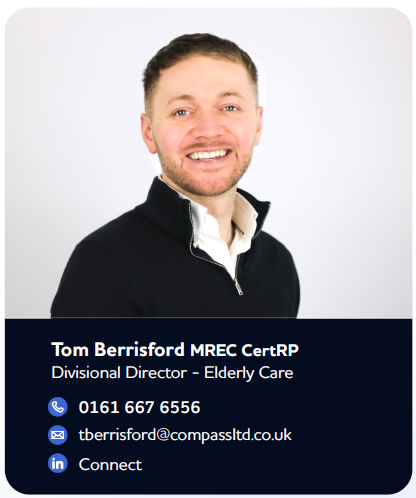
Tom Berrisford, Divisional Director of Elderly Care at Compass Associates
In the first article of our series on building commercial capability in Elderly Care, Divisional Director Tom Berrisford explores the factors driving the significant rise in the commercial roles being recruited across elderly care providers, and how this is contributing to sustainable growth and stronger ROI.
Commercial teams are becoming an increasingly established feature of the elderly care sector, driven by a combination of structural and commercial pressures. Providers are facing the need to maintain occupancy, manage rising operating costs and respond to the growing importance of the private-pay market.
Together, these factors are prompting a fundamental shift in how providers approach commercial growth. Responsibility for occupancy and business development is increasingly moving beyond the traditional remit of the home manager, with dedicated commercial expertise becoming an increasingly important part of the organisational structure.
“A home manager cannot manage commercial growth, run the staff team, maintain care quality and manage every stakeholder relationship at once. Something has to give, and increasingly, providers are recognising that something should be a dedicated commercial function.”
What’s behind the shift toward dedicated commercial teams in Elderly Care?
The customer journey has become increasingly complex, shaped by emerging technology, higher consumer expectations and wider cultural shifts. Elderly Care providers have had to adapt accordingly. Providers are now considering the full journey that a prospective resident and their family experience – from the initial enquiry and first telephone conversation – to the online experience they encounter before making contact and the reputation that shapes their expectations.
This represents a significant expansion of the commercial responsibilities within a care home. These demands sit alongside, rather than replace, the operational, clinical and regulatory responsibilities traditionally held by the home manager, creating a stronger case for dedicated commercial expertise within the wider organisation.
As a result, we are seeing regional sales, business development, customer relationship, inquiry-advisor and marketing roles are all becoming more visible across the sector. These roles exist as a dedicated function to focus on revenue, occupancy and reputation, while home managers focus on the operational side: staffing, care quality and stakeholder relationships. It is a division of labour that is increasingly common in larger and more ambitious organisations, and I expect dedicated commercial functions to become standard practice, even if the exact structure varies from one provider to the next.
Part of what is driving this is the broader move by some providers toward the private market, where competition for residents is more direct and the commercial case for investing in attraction, reputation and service is clearer. As more operators position homes as premium, private-pay services, offering additional facilities and value-added features, the commercial function stops being a nice-to-have and becomes central to how a home competes and fills beds.
The growing importance of Customer Relationship Management
There is no single blueprint for how providers are building this capability. Some are appointing site-based customer relationship managers (CRMs) who sit alongside a home manager at an individual service, giving that home a dedicated point of contact for inquiries, walkarounds and family engagement. Others are building centralised teams that support websites and inquiries across a wider portfolio of homes, giving smaller or more geographically spread providers a way to access commercial capability without needing a dedicated hire at every site.
Both models can work well, and the right choice tends to come down to the size of the provider, the number of homes involved, and how much local, service-specific engagement a business wants its commercial team to have. Customer relationship managers are becoming increasingly common in this space, particularly in larger boutique or luxury care services. A CRM typically manages enquiries and the attraction process, conducts walkarounds, and shows families the facilities and community links, while the home manager focuses on operations.
We have been approached consistently by providers for CRM-based roles over the last two to three years, and that demand is directly linked to increased competition in the private market: providers offering more facilities, more value-added features and greater access to residents and their families are finding they need a dedicated commercial presence to compete on service, not just on price or location.
The hotel comparison that explains where this is heading
“The easiest way I can explain where this is going is to compare it to hospitality. Think of a small, luxury boutique hotel, where the general manager genuinely does everything: sales, marketing, guest relations, operations, all of it.”
That is broadly where the home manager role sits today in a lot of elderly care. Now think of a larger hotel chain, where the general manager is solely responsible for running operations on that site, and there is a separate, dedicated sales and marketing team working alongside them. That is the direction elderly care is heading in, certainly among the larger and more ambitious operators. The home manager’s role becomes more clearly about running the service, while commercial specialists handle the attraction and reputation piece.
Where the line sits between commercial and operational hiring
This growing demand for commercial capability raises a question we hear from almost every provider we work with: where should this talent actually come from? Candidates with backgrounds in hospitality or retail are increasingly moving into commercial marketing roles in elderly care, and that cross-sector experience translates more directly than many providers assume.
“Commercial and marketing skills transfer across industries in a way that care operations generally does not. Operations still requires the understanding that comes from working in social care. But attraction, service and reputation are skills a strong hospitality or retail candidate already has and can apply it to almost any sector.”
It is worth being clear about where this logic does and does not apply. Care operations, of course, generally requires the grounding that comes from having worked in social care, and many of the strongest operations and quality leaders in this sector have progressed up through care roles. That understanding of regulation, resident needs and the realities of running a home is not something that transfers easily from another industry.
Commercial and marketing roles are a different story and I believe can benefit this industry given their fresh perspectives on what customer journey should look like. These candidates need to understand how to market a physical, residential service, and to grasp the differences between individual homes and locations, but they do not need years of social care experience to be effective. What they do need is the same attention to detail, service culture and understanding of attraction and conversion that they would have built in a business to consumer (B2C) environment.
Leaders who focus only on spreadsheet numbers and rarely visit homes in person risk missing the operational and local context that makes commercial activity effective, whatever sector they came from. The attraction process is also a distinct skill; conducting walkarounds and explaining how a resident might genuinely fit into a home and its local community, and strong commercial hires need to be comfortable with both sides of the coin in that respect.
This year alone, I have spoken to four or five different operators who hired a finance director or commercial director who never actually gets out into the homes, and it shows. A care home in Dundee is a completely different proposition to a care home in Belgravia, or a care home in Blackpool: different community, different family expectations, different competitive set. The processes may be broadly similar, but every home is different, and a commercial hire who is only looking at the bottom line will miss that. It is also worth being clear about the kind of commercial mindset that works best here: the strongest hires tend to be genuinely consumer-facing, or B2C, in their thinking, comfortable with the idea that there is no one-size-fits-all approach and that what works for one home may not work for the next.
Why investors are watching commercial growth closely too
Investors are focused on occupancy, revenue and whether a home or service is operating commercially, and that focus becomes particularly acute around a sale, purchase or exit process. Regulatory performance matters and does have an effect, but investors are more likely to commit capital to models that are demonstrably working on a commercial basis.
Commercial staff who are close to occupancy and operating performance can play a genuinely useful role in those conversations, helping providers articulate their commercial story clearly during an exit process, alongside the regulatory picture. Providers seeking growth, or preparing for a future sale, need a commercial person who is genuinely close to occupancy and operating performance, not just reporting on it after the fact.
What this means for elderly care providers looking to grow
For providers still relying on home managers to carry commercial responsibility alone, this is a moment worth pausing on. The businesses seeing the strongest results with inquiries, conversions and occupancy are, in my experience, the ones that have separated commercial ownership from operational ownership, even where the two roles work closely together.
If you are struggling to fill commercial or marketing vacancies with candidates from within elderly care, it is worth considering other sector experience: consumer focussed backgrounds are producing genuinely strong commercial hires across the sector, provided the individual is willing to get close to the service itself rather than operate at arm’s length. Reserve the sector-specific hiring bar for operational and care roles, and be more open-minded on commercial ones.
Looking for recruitment support?
At Compass Associates, we understand the complexities of building commercial teams within elderly care and the importance of finding the right people to drive sustainable growth and ROI. Whether you are building a commercial function from the ground up or strengthening an existing team, our specialist consultants can help you identify the experience, skills and leadership capability your organisation needs.
Get in touch to discuss how we can support your growth.
Register a vacancy Visit our Case StudiesVisit our Case Studies