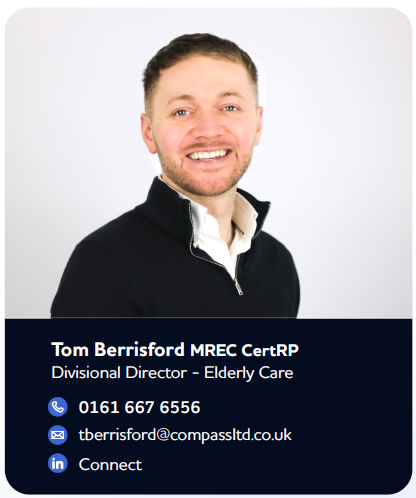
Tom Berrisford, Divisional Director of Elderly Care at Compass Associates
In the third and final instalment of our series exploring how to build commercially focused teams in elderly care, Divisional Director Tom Berrisford explores where Q2 investment is flowing across the elderly care and senior living market, and what this means for organisations looking to secure commercial talent in the months ahead.
Building a commercial team does not happen in a vacuum. Two further pieces of Q3 market context are worth factoring into any provider’s planning: where investment is actually flowing within the elderly care and senior-living market, and when the next few months represent the best window to secure commercial talent before the market slows down.
Why care homes – not retirement villages – are winning investment
Investment activity in elderly care has raised a recurring question from providers: has the US senior-living model, with its emphasis on retirement communities, started to influence the UK market? The honest answer is a qualified yes, and Welltower’s UK investment is one of the clearest examples of that influence taking hold. But the picture is more nuanced than a straight import of the US model, and understanding why matters for how providers think about growth and positioning.
“Retirement living, where older people buy a flat in a retirement village, is not doing as well in the UK as the care home model. Care homes are the growth market here, and increasingly, some of them offer a standard of luxury living that looks a lot like a senior-living facility.”
In the US and Australia, retirement living has performed well, helped by demographic and lifestyle patterns such as older people relocating to places like Florida for their retirement years. The UK market has not seen the same dynamic play out. A retirement-living flat can cost in the region of half a million pounds, a price point that can be unattractive to a 60- or 70-year-old couple who do not yet need the level of support a luxury care home or nursing home provides. There is also a structural risk built into the model worth understanding: some residents who move into retirement living later develop care needs, and at that point can find it difficult to sell their flat, effectively leaving them tied to a property that no longer suits their circumstances.
Care homes, by contrast, are a genuine growth market in the UK, and the more successful operators are increasingly blurring the line between traditional residential care and the premium senior-living experience associated with the US model. Luxury facilities, added services and a stronger focus on lifestyle and experience are appearing within the care home sector itself, rather than in a separate retirement-village category. There is also a recognised middle ground worth watching: a proportion of older people are choosing to downsize rather than commit to either a retirement-village flat or residential care. That trend has not yet crystallised into a single clear model in the UK, but it is a space that providers thinking about future service design should keep in view. For providers considering how to position new developments or refurbishments, the UK evidence to date favours investment in premium, service-rich care homes over standalone retirement-village schemes.
Why the next few months matter more than January for hiring
Providers are seeing an increase in jobs and vacancies, and the period after the summer holidays is typically when people start reflecting on whether they want a new role. That reflection can come from wanting to grow or progress, feeling bored, not doing well in a current position, or simply being ready for a change for its own sake.
“Understand why people are moving, rather than assuming everyone looking for a role has a clear reason. This is also a good opportunity to speak to people who have been with their employer for a while and may be starting to consider a move.”
Of course, not every candidate who is open to a conversation right now is moving for the same reason, and providers who take the time to understand what is actually driving someone’s interest in a new role are better placed to make the right offer, and the right pitch, than those who simply react to availability. It is worth being cautious of the “new year, new me” crowd who resurface every January looking for change for its own sake, but genuinely worth engaging with people who have been in their current role for a while and are starting to consider a move for real reasons: wanting to grow, wanting to progress, or simply feeling ready for something different. This is also a good moment to proactively reach out to strong performers who have been with their current employer for a while. People who are not actively job-hunting are often still open to the right conversation at this point in the year.
Timing has a real practical impact here. Someone giving notice now could realistically start a new role three months later, in the new year, which means acting during this window sets a provider up well for January starts without the scramble of a live vacancy. Waiting until January to begin a search, by contrast, tends to be less effective: people are generally less inclined to move at that point in the year, for reasons tied to the season and to their own finances, having just come through the Christmas period.
What this means for elderly care providers
If you are planning to build or grow a commercial function in the next two to three quarters, the practical advice is straightforward: start the conversation now. Use the window before the year-end slowdown to understand who is genuinely considering a move and why, rather than waiting until January when both the pool of active candidates and their appetite to move typically shrink.
- Make your hiring objectives clear now rather than in the new year, while candidate movement is active
- Understand candidates’ underlying motivation for moving, not just their availability
- Factor in notice periods of around three months when planning start dates for January
- Use this window to re-engage long-tenured strong performers who may be open to the right opportunity
- Weigh investment and development decisions toward care-home-based, service-rich models rather than standalone retirement-village schemes
Looking for recruitment support?
As the longest-serving and most established team at Compass Associates, our Elderly Care team supports the recruitment of senior management across residential care, homecare, retirement living, nursing and clinical services nationwide.
Whether you are building a marketing function, developing a commercial team or strengthening an existing division, our specialist consultants can help you identify the skills, experience and leadership capability needed to support your organisation’s growth.
Get in touch to discuss how we can support your commercial hiring strategy.
Register a vacancy Visit our Case StudiesVisit our Case Studies